

Over half of american professionals now report working remotely at least part of the week, yet balancing home life with career demands often feels like a puzzle with missing pieces. The shift from office to home has introduced new freedoms but also new pressures that can blur the lines between work and personal well-being. By understanding the core elements of remote work life balance, you can build habits and routines that protect your time, improve productivity, and support a healthier lifestyle.
Table of Contents
- Defining Remote Work Life Balance
- Key Challenges And Common Misconceptions
- Essential Strategies For Achieving Balance
- Optimizing Home Organization For Productivity
- Mistakes To Avoid While Working Remotely
Key Takeaways
| Point | Details |
|---|---|
| Holistic Approach | Remote work life balance requires integrating professional responsibilities with personal well-being in a flexible manner. |
| Boundary Management | Establishing clear boundaries between work and personal time is crucial for maintaining mental health and productivity. |
| Effective Workspace Design | Creating a dedicated and ergonomic workspace minimizes distractions and enhances focus. |
| Continuous Adaptation | Achieving balance is a dynamic process requiring ongoing self-awareness and strategic planning to meet personal and professional needs. |
Defining Remote Work Life Balance
Remote work life balance represents a holistic approach to integrating professional responsibilities with personal well-being in a digital work environment. Unlike traditional office settings, remote work demands a nuanced strategy for maintaining boundaries between professional tasks and personal life. At its core, this concept goes beyond simply working from home - it’s about creating a sustainable ecosystem where productivity and personal satisfaction coexist harmoniously.
Research demonstrates that successful remote work life balance hinges on strategic flexibility and intentional time management. Empirical studies reveal that employees who effectively manage their work environments experience enhanced job outcomes through increased autonomy and reduced organizational constraints. This means establishing clear structures while simultaneously allowing personal adaptation and self-regulation.
Effective remote work life balance involves several critical components:
- Boundary Setting: Clearly delineating work hours and personal time
- Workspace Design: Creating a dedicated, ergonomic work area separate from relaxation spaces
- Technology Management: Utilizing digital tools that support productivity without causing burnout
- Self-Care Practices: Incorporating regular breaks, physical movement, and mental health strategies
Ultimately, remote work life balance is a personalized journey that requires continuous adjustment and self-awareness. Work life balance strategies emphasize the importance of individual approaches tailored to unique professional and personal circumstances. The goal isn’t achieving a perfect, static state, but developing a dynamic, responsive system that supports both professional excellence and personal fulfillment.
Key Challenges and Common Misconceptions
Remote work life balance is fraught with complex challenges that often contradict popular assumptions. One significant misconception is that working from home automatically translates to greater personal freedom and reduced stress. Research exploring the flexibility paradox reveals a more nuanced reality, where telecommunications and online interactions can actually lead to increased mental exhaustion and professional fatigue.
Among the most prevalent challenges are boundary blurring and workload management. Studies in the IT sector demonstrate that remote work can unexpectedly increase professional workloads, challenging the perception that working from home inherently reduces work pressure. Many professionals struggle with:
- Difficulty disconnecting from work
- Increased screen time and digital communication
- Reduced physical movement
- Potential social isolation
Another critical misconception is assuming that remote work provides uniform flexibility for all employees. Individual circumstances, home environments, and personal capabilities significantly impact one’s ability to maintain effective work-life boundaries. This variability means that a one-size-fits-all approach to remote work is fundamentally flawed.
Moreover, psychological challenges are often overlooked. The transition to remote work demands substantial self-discipline, emotional intelligence, and proactive communication strategies. Professionals must develop robust personal management skills to navigate the complex landscape of digital work environments, transforming potential challenges into opportunities for professional growth and personal well-being.
Essential Strategies for Achieving Balance
Achieving sustainable remote work life balance requires a multifaceted approach that combines intentional planning, self-awareness, and strategic personal management. Research on job satisfaction emphasizes that successful work-life integration depends on implementing targeted strategies that support both professional performance and personal well-being.
Key strategies for maintaining effective remote work balance include:
- Time Blocking: Allocate specific hours for work, personal activities, and rest
- Digital Boundaries: Establish clear communication protocols and technology usage limits
- Physical Workspace Design: Create a dedicated, ergonomic home office area
- Regular Self-Assessment: Continuously evaluate and adjust work-life integration approaches
Professionals must also develop robust mental resilience and communication skills. This involves proactively managing expectations with employers, setting realistic productivity goals, and creating structured routines that prevent burnout. Organizational support systems can play a crucial role in helping remote workers maintain healthy boundaries and sustainable work practices.
Ultimately, achieving balance is a dynamic process that requires ongoing adaptation. Successful remote workers recognize that balance isn’t a static destination but a continuous journey of personal growth, self-management, and intentional lifestyle design. By implementing thoughtful strategies and remaining flexible, professionals can transform remote work challenges into opportunities for enhanced productivity and personal satisfaction.
Optimizing Home Organization for Productivity
Research on remote work environments demonstrates that a well-organized workspace is fundamental to maintaining high productivity and professional effectiveness. The physical environment directly influences mental clarity, focus, and overall work performance, making home organization a critical component of successful remote work strategies.
Key elements of an optimized home workspace include:
- Dedicated Work Zone: Establish a specific area exclusively for professional activities
- Ergonomic Setup: Invest in comfortable, supportive furniture and proper equipment placement
- Minimal Clutter: Implement smart storage solutions that reduce visual distractions
- Technology Management: Create efficient cable management and digital organization systems
- Lighting and Ambiance: Ensure adequate natural and artificial lighting for optimal work conditions
Professionals must recognize that home organization fundamentals extend beyond physical arrangement. The goal is creating a holistic environment that supports cognitive performance, mental well-being, and seamless professional functionality. This approach transforms home spaces from mere living areas into dynamic, productive work environments.

Ultimately, home organization for remote work is a personalized journey of continuous adaptation. By thoughtfully designing physical spaces that align with individual work styles and professional requirements, remote workers can create powerful productivity ecosystems that enhance both professional output and personal satisfaction.
Mistakes to Avoid While Working Remotely
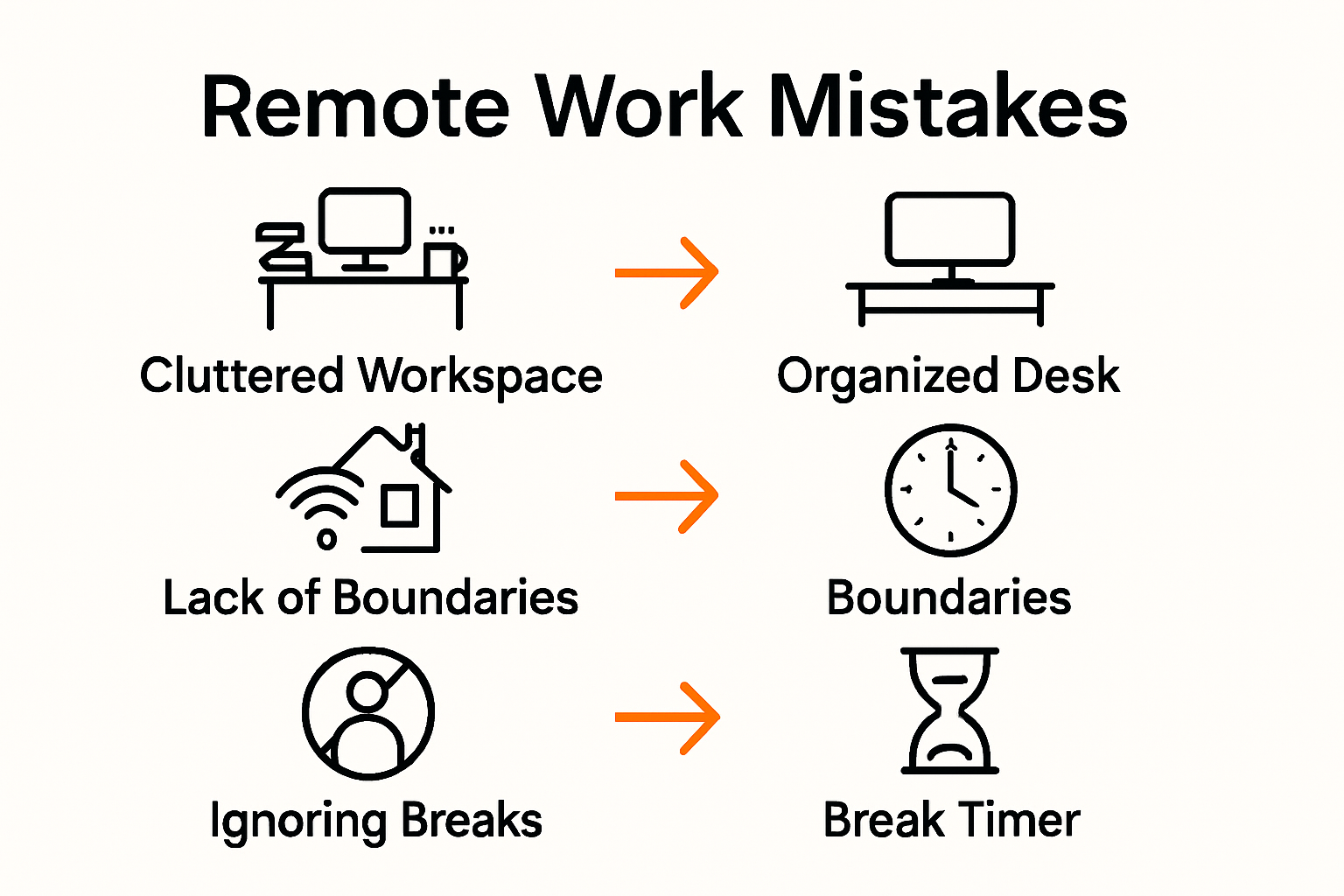
Research investigating remote work challenges reveals that professionals frequently encounter subtle yet significant obstacles that can dramatically undermine productivity and work-life balance. Understanding these potential pitfalls is crucial for developing effective remote work strategies that protect both professional performance and personal well-being.
Common mistakes remote workers must proactively avoid include:
- Blurred Boundaries: Allowing work to consistently encroach on personal time
- Communication Breakdown: Failing to maintain clear, consistent professional interactions
- Isolation Syndrome: Neglecting social connections and professional networking
- Ergonomic Negligence: Ignoring physical workspace setup and health considerations
- Technology Dependency: Over-relying on digital communication without meaningful engagement
Organizational research on work-life balance emphasizes that successful remote professionals must develop intentional strategies to mitigate these challenges. This requires a holistic approach that balances technological proficiency, emotional intelligence, and personal discipline. Home organization techniques can play a significant role in creating structured, productive remote work environments.
Ultimately, avoiding remote work mistakes is an ongoing process of self-awareness and continuous adaptation. By recognizing potential pitfalls, implementing targeted strategies, and remaining flexible, professionals can transform potential challenges into opportunities for growth, productivity, and personal satisfaction.
Transform Your Remote Work Life with Smart Home Organization
Struggling to maintain clear boundaries between work and personal life at home The Complete Guide to Remote Work Life Balance highlights the importance of a dedicated, clutter-free workspace and intentional home organization to boost productivity and well-being You deserve a home environment that supports focus without sacrificing comfort or style

Discover stylish and functional storage solutions at Blush Bees designed to create organized work zones that reduce distractions and support your mental clarity Choose from durable storage boxes, baskets, and dividers tailored to turn any space into a productive haven Take control of your remote work routine today with smart organization that makes balance attainable Visit Blush Bees and find the perfect storage options that empower your remote work life balance journey now
Frequently Asked Questions
What is remote work life balance?
Remote work life balance refers to the integration of professional responsibilities with personal well-being in a digital work environment, emphasizing the need to maintain boundaries between work tasks and personal life.
How can I effectively set boundaries while working remotely?
You can set boundaries by clearly delineating your work hours, creating a dedicated workspace, and establishing digital communication protocols that outline when and how you are available for work-related matters.
What are some strategies to enhance productivity while working from home?
Strategies to enhance productivity include time blocking for work and personal activities, designing an ergonomic workspace, and regularly assessing your work-life integration approaches to ensure they align with your needs.
What common mistakes should I avoid while working remotely?
Common mistakes include blurring work and personal boundaries, neglecting social connections, poor ergonomic setups, and relying too heavily on digital communication without meaningful engagement.
Recommended
- Work Life Balance Tips: Complete Expert Guide – BLUSHBEES USA
- Ways to Relax at Home: Complete Guide for 2025 – BLUSHBEES USA
- Wellness at Home: Everything You Need to Know – BLUSHBEES USA
- Healthy Daily Habits: Complete Guide for Busy Homes – BLUSHBEES USA
- The perpetual traveller: What are the advantages of being one? - EBC Trinity CertTESOL and TEFL courses


